Category Archives: Church planting

Table Talk

Eucharist 02At LifeSpring Church we believe that everybody should be able to participate as fully as they would like.  So we give people ample opportunity to volunteer to lead congregational prayers, read scripture, and provide the Lord’s Supper meditation, which we call the “table talk.” 

When we started doing this over a year ago, you could see some awkwardness.  We didn’t know each other that well at that point.  Folks didn’t know what was expected of them.  Most of us had grown up believing that such involvements should be reserved for an elite group of leaders.

But now our church community has grown comfortable with our egalitarian approach to worship and participation.  Everyone feels included and appreciated.  We are often blown away by the profundity of what is shared in communion mediations, or we’re moved by the skillful reading of a text.  It’s a really neat process in which to participate.

Yesterday Sean told us about the changes he has experienced in the last two years of his life.  He said that the Lord’s Supper is like a “pit stop” on the Amazing Race television show.  It has served to slow him down and make him think about what is happening in his life and the Lord’s relationship to that.  I was thankful for Sean’s transparency as well as for the eloquence of what he shared with us.  He made the Lord’s sacrifice real for us.

I am glad that LifeSpring recognizes the strength of everyone sharing.  By getting to hear what was on Sean’s heart, my life was improved.  Now I can’t wait to hear what the next LifeSpringer shares.

New Barna Book

UnChristianI just bought a new book called unChristian.  I found out about it through an electronic newsletter and was intrigued by the premise of the book.  Author David Kinnaman works for The Barna Group, an organization that provides primary research and tools for churches and parachurch organizations.

My interest in the book began because of a resonance I have with the author’s thesis.  “Our research shows that many of those outside of Christianity, especially younger adults, have little trust in the Christian faith, and esteem for the lifestyle of Christ followers is quickly fading among outsiders.”

I just started the book.  More about it in a later blog.  However, below is a CNN interview with Gabe Lyons, one of the writers of the book.  You may also enjoy looking at a site designed to create dialogue about relevance to culture. 


Christmas Parade

Santa 01Today, December 1, was the day of Merced’s annual Christmas parade.  The parade route went down Main Street right past Playhouse Merced.  LifeSpring was invited to put up a table inside the Playhouse entry way, right next to the sidewalk.  We all thought that was a good idea, although we didn’t know what to expect.

In a planning meeting it was suggested that we serve coffee or hot chocolate to parade goers.  LifeSpringers also brought homemade cookies to serve, but it was soon discovered that we didn’t have nearly enough.  The parade crowd was huge.  An emergency run was made to purchase more, and by parade end, all of the cookies were gone.

Our team agreed that the event was a huge success.  We gave away 200 drinks.  We gave away even more cookies.  Several LifeSpring invitation cards were taken, and we provided a very positive image of our church community.  Probably the best outcome was the enormous fun that we all had working together to do something good.

After the parade was concluded LifeSpring conversations began about how we would improve on what we just did.  A number of excellent suggestions were made, and we’ll be even better prepared next time.

Teamwork

Teamwork 01One of the greatest sins a “leader” can commit is to work alone.  Good leadership equips, empowers, trusts, and releases.  The best way to do this is through teams, and this is a good definition of team.  “A team is a group organized to work together to accomplish a set of objectives that cannot be achieved effectively by individuals.” 

Teamwork is the wisest means by which to contribute to an organization.  An organization that does not use teams is limited by the capabilities of its weakest or most fearful leader. 

Weak leaders function like log jams that slow everyone else down or even prevent forward motion.  Fears, vested interests, ego, or prejudices can hamper the health and effectiveness of an organization.

That’s why teams are important.  In teams, everyone has a vital role to play, everyone is empowered to contribute, and every opinion is important in the formation of direction.  Teams also require humility to function correctly.  A “leader” with huge ego issues will not be able to function in a team setting; it will be too threatening.

The same article about teams, quoted above, has a set of guidelines for team membership.  The whole list is not printed here, but note the emphasis on individual contribution in the items listed.

  • Contribute ideas and solutions
  • Recognize and respect differences in others
  • Value the ideas and contributions of others
  • Listen and share information
  • Be flexible and respect the partnership created by a team — strive for the “win-win”

Autocratic and egotistic leaders are only able to reach to their personal limits.  In team work, individual commitment usually transcends the team. A team outperforms an individual and all reasonable expectations given to its individual members. That is, a team has a synergistic effect…one plus one equals a lot more than two.

Jesus understood the importance of “team” and its ability to transform individuals.  He took 12 men who, individually, could never have accomplished what they did as a team in a few short years.  During his three years with them, he empowered them, allowed them to fail, and when needed, supplied specific teaching.

Teamwork is vital to healthy organizations, business or religious.  An individual that tries to “lead” by himself is a danger to progress and growth, because he will function like a governor on a motor and slow the organization to his own limitations.

SermonSpice dot com

Sermon Spice 02One of my favorite sermon resource sites is SermonSpice dot com.  I have been using them for a few years now, and I never cease to be amazed at the wonderful variety that I find at the site.

What’s neat is that SermonSpice is located just down the around about 60 miles in Fresno.  That really makes no difference in the service however.  They are always helpful and effective.

I would not hesitate to recommend them for someone looking for the right video idea to illustrate a sermon or some other spot in the worship.  Check them out.

Never Eat Alone

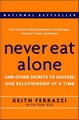
NeverEatAloneI just finished Keith Ferrazzi’s excellent book, Never Eat Alone.  I found out about the book from several references to it on LinkedIn’s excellent business networking site.  Still, you never know what you’re going to find when you buy a book based on others’ recommendations.

Almost from the first page of the book I was hooked.  I knew that Ferrazzi had a different take on things than most business success types.  He knows that no one is “self-made” in the strictest sense of the word.  We’re all in this together, and people who are generous to others are the most successful in their pursuits.  Here are a few quotes from Ferrazzi.  

  • Poverty, I realized, wasn’t only a lack of financial resources; it was isolation from the kind of people that could help you make more of yourself, page 5.
  • I learned that ‘real’ networking was about finding ways to make ‘other people more successful, page 9.
  • “So you want the inside scoop,” I respond.  “Fair enough.  I’ll sum up the key to success in one word:  generosity,” page 14.
  • Autonomy is a life vest made out of sand, page 17.
  • In other words, the currency of real networking is not greed but generosity, page 21.
  • I would argue that your relationships with others are your finest, most credible expression of who you are and what you have to offer, page 22.

I think the book has indispensable information for anyone that is wanting to connect with the world around.  I find it to be especially relevant in a church planting context and would immediately recommend it as a “must read” book.  Ferrazzi also has a blog which is fun to read.  Enjoy.

“Let me buy you a coffee.”

StarbucksYesterday I was in line at Starbucks for my morning cup of coffee.  There were about four or five people in front of me, including the man with the stand-up collar.  He looked like a business man, and the collar was an accident.
I debated with myself whether to say anything.  Every once in a while I bump into someone who doesn’t want to be bothered so I wondered if he would be irritated if I mentioned his collar.  I decided to take the risk.

Continue reading “Let me buy you a coffee.”

Missio Dei

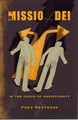
Missio DeiFred Peatross, from Huntington, West Virginia, is a friend of mine that I’ve never met in person.  Our relationship is facilitated by e-mail.  I live in California.  We became friends because of Jim Henderson who lives in Seattle, Washington.  West Virginia, California, and Washington—this is a great picture of our times.

Fred’s new book, Missio Dei, is an insightful look at what is happening in Western culture, particularly as it relates to disciples of Jesus.  Twenty years ago the e-mail relationship Fred and I have developed would have been unheard of.  Also blogging, Google, My Space, and social networking.

Continue reading Missio Dei