 Amos was an ancient prophet writing in the 8th century to an Israel that had become corrupt, self-satisfied, and indifferent. During his reign, Israel’s wicked king, Jereboam II, seized political opportunity to gain control of trade routes and create commercial prosperity. His action created a wealthy class living in great luxury. Exploitation of the poor and other excesses were the byproduct of his corrupt rule. Continue reading An Ancient Warning
Category Archives: theology
The Sufficiency of Jesus
 A friend of mine commented recently that she had not been taught a great deal about the nature of Jesus even though she had grown up in a church community. It’s a curiosity that one could grow up in a culture and not know what the bedrock of its beliefs are, but it’s common.
There was an first century church community that had similar problems, exaggerated by persecutions they were experiencing. The message that a writer sent to them was, “Don’t give up.” But they had to have a reason not to give up. That is the basic idea behind the New Testament book of Hebrews. Continue reading The Sufficiency of Jesus
Preaching on the subject of marriage is hard.
Hermeneutics is the art of interpretation, and it is used in everything we do from trying to decide what a road sign means to reading a comic strip. A street my family used to live on had a sign which said, “Caution slow children playing.” Without punctuation I had to decide if it was warning me about slow children or if I was being advised to slow down because children were playing. Hermeneutics.
Some of the passages about marriage and relationships require similar art when trying to apply their ancient instruction to 21st century contexts. Peter, for example, told women to not braid their hair and praised Sarah for calling Abraham “Lord.”
This week’s sermon is the second in a series on relationships and is an attempt to find the universal ideas about marriage that are applicable at all times and in all cultures. Did Peter really mean that women couldn’t braid their hair or was he warning against looking like a side of culture that is godless and immoral? That is the question of hermeneutics.’
Marriage is one of my least favorite topics to speak about. Why? Because of the amount of pain and brokenness that exists in regard to that subject. In any group of people listening to a sermon on marriage will be those who grew up in broken, fractured families. Who have suffered their own marital versions of heartache, abuse, and rejection. There will be a relative minority of folks who have long marriages in the audience.
The challenge of speaking on such a subject is to present the ideas in a way that is constructive and healing, not accusatory and hurtful. The cultural distance between the times of the Bible and today is huge and trying to speak from those texts without recognizing the distance only results in confusion and pain.
One of the premier texts about relationships between husbands and wives begins in Ephesians 5:21, “be submissive to one another out of reverence for Christ…” When I did a search on that text in a software study program I use, it conveniently started at verse 22, “wives be subject to your husbands…”
I doubt that calling one’s husband “lord,” as Peter said or “wives being submissive to husbands” is the solution to marital brokenness. But the idea of mutual respect (husband to wife and vice versa) is a curative that will work. That’s what I want to convey.
God at work…
It’s easy to become a whiner. Life gets hard. Challenges arise. Obstacles interfere. “God, where are you? Why aren’t you making my life easier?”
At those times it is helpful to hear about how others negotiate trying times. People like Nick Vujicic in this video put life in perspective and eliminate the whining. Watch this and be inspired.
Don’t be frightened away by the Japanese subtitles. The entire video is spoken in English. The link below will take you to the video site.
Whatever
 When our daughter was in high school and feeling omniscient, she had a phrase that she used to repel any attempt to enlighten her or explain some idea. The word was “whatever,” and it was guaranteed to stop any further conversation as she served notice that she had no interest at all in what was being said by her parent. “Whatever” was the ultimate definition of indifference or scorn. Fortunately, she outgrew this.
Whatever has other definitions. 1. Everything or anything: “Do whatever you please.” 2. No matter what: “Whatever happens, we’ll meet here tonight.” 3. Any number or kind: “Whatever requests you make will be granted.”
There are some other definitions, but this gives a good idea of its absence of a specific reference. Whatever is used in interesting ways in the Bible and gives some insight into the kind of freedom that God gives us all. To the disciples Jesus said, “Whatever town or village you enter, find out who in it is worthy, and stay there until you leave.” By so indicating, Jesus gave his disciples the freedom to choose the towns they would go to.”
The writer, Paul, told the church at Corinth that whatever they did, should be done for God’s glory. The only boundary or limitation that Paul placed on their activity was that it be God glorifying.
The writer, James, took this a step further and said that to knowingly fail to do something something good is sin. So there is an accountability that is laid on us to make good personal judgments and act on them. It is as if God is saying to us, “Do something good.”
In Philippians 4:8 we are given the freedom to dwell on any and everything that is true, noble, right, pure, lovely, admirable or praiseworthy. Permission is not needed. We have carte blanche on these good things. We are also accorded similar freedoms in prayer. Whatever you ask…” Jesus said.
God gives his people enormous freedom to act on the many good choices around them. Doing good has God’s endorsement and has already been approved as long as it is for God’s glory. That’s a no brainer.
Funeral
 I found out last Friday that a friend had died. I knew her at a previous church for which I worked. She had been an insulin dependent diabetic since age 3. I was always impressed by her personal discipline. Had she not been, I doubt she would have survived until her late 50’s.
The recent death came on the heels of what the doctors think could have been a stroke or a fast moving infection. Whatever it was took her life quickly. Though it was painful to her family to lose her, it was actually a grace. She did not have to exist in a hospital or go through lengthy suffering.
She was a person of great faith. So if she had known she was coming to the moment of her death, I think she would have said, “This is the moment I have been getting ready for.” All of us who knew her watched her live with great spiritual integrity and hope. Death was just another stage of her journey toward God.
So on the day before Thanksgiving I will have the blessing of talking about her life. It will be a pleasure because of the inspiration and hope she gives me. She died in victory.
Predicting
 I was working on a sermon recently that was exploring the idea of being prepared for the Second Coming, whenever that happens. The language of the New Testament seems to indicate that the First Century disciples believed that the Second Coming was imminent. Some were, apparently, quitting their jobs in order to wait. Others were afraid that it had already happened and they had missed it.
Interest and concern about the Second Coming is not unusual. It persists today as evidenced by the plethora of workshops, books, and seminars purporting to predict the time when Jesus is coming back. Hal Lindsey’s books sold widely because they promised answers. But all they did was create unnecessary angst.
Christian Century (November 13, 2007) recently reported that Ronald Reagan once said that the Chernobyl crisis had been predicted in Revelation 8. In that chapter’s description of the opening of the seventh seal, a great star fell out of the sky which caused people to die from resulting bitter waters. Reagan said “the star was called Wedgewood which translates as Chernobyl in Ukrainian.”
The reporter who wrote the story later looked up the reference and discovered that the star was called “Wormwood” instead. Whoops!
Which is what I want to say about all the predicting that goes on. Whoops! I wish all those folks would listen to what Jesus said and believe him. “…about that day and hour no one knows, neither the angels of heaven, nor the Son, but only the Father,” Matthew 24:36. “Keep awake therefore, for you know neither the day nor the hour,” Matthew 25:13.
Jesus said to be prepared, not to engage in predicting. Jesus’ way provides confidence and hope. Prediction only produces anxiety, which was not something Jesus was into.
New Book
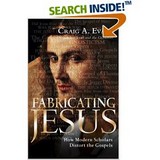 A few months ago I bought a book on a whim from InterVarsity Press. IVP is a really great publishing company, and they consistently print thought provoking and balanced books on a variety of subjects. Fabricating Jesus is no exception to this.
The author, Craig Evans, is Payzant Distinguished Professor of New Testament at Acadia Divinity College in Wolfville, Nova Scotia. In Fabricating Jesus he takes to task the narrow, brittle point of view of fundamentalism.
I grew up in a fundamentalist culture, so what he writes strikes home with me. I’ve heard the same phrases that Evans cites, and I’ve seen some of my friends leave faith, God, and church because of the untenable positions they accepted.
Evans calls fundamentalism’s point of view “cramped starting points, which often are little more than presuppositions and not documented and argued conclusions,” page 34. He says, “I have heard fundamentalists say, “Show me one mistake in the Bible and I will throw out the whole thing,” page 31. The problem with this is that the moment a person discovers something they didn’t expect, their faith is at great risk.
I think a similar risk exists with those who allow bad theology to govern their thinking about God. So, based on that theology, when God disappoints them, they abandon their faith.
One of my favorite quotes is Evans’ assertion that “The truth of the Christian message hinges not on the inerrancy of Scripture or on our ability to harmonize the four Gospels but on the resurrection of Jesus,” page 31. This is certainly what Paul the apostle declared to the Christians at Corinth.
I handed on to you as of first importance, what I in turn had received:that Christ died for our sins…that he was buried, and that he was raised on the third day… 1 Corinthians 15:3,4.
Truly.
Kindness
 Gavin Whitsett wrote the book,, Guerilla Kindness, and was the father of the Random Acts of Kindness movement. Whitsett said that he wanted to remind people of the kind impulses that all of us had. In a world that is often rude and unkind, it’s nice to have the reminder.
The Bible also reminds us of the importance of kindness. Micah said in answer to the question, “What does God require of you?” Do justice, love kindness, and walk humbly with God, Micah 6:8.
In today’s sermon we began a list deeds that are expressions of kindness. All of these deeds require attention and determination, and they do not occur by accident. Below is a beginning list of suggested kind deeds. Kindness, by its nature, is otherly. What would you add to the list?
It was meant to be….
 I hear it all the time. It comes in some version of “it was meant to be.” People who are not God followers tend to talk about fate or some amorphous Cause that created a situation.
Believers credit God with the green car they just bought or the perfect job they just got. The Christian version of it-was-meant-to-be is “God told me to do this.” Oh really?
This is not a diatribe against being thankful to God for answered prayer. The Bible actually encourages us to give thanks in all circumstances. However…
 MonoLogue