In 1947, the year I was born, television had been invented and was being used in some U.S. households that could be measured in the thousands. However, by the late 90’s, 98% of U.S. homes had at least one television that was one for more than 7 hours per day.
At 2801 S. Taylor Street in Little Rock I had a world of wonder at my doorstep, and I don’t remember ever telling my mother that I was bored. A huge white boulder in our back yard was a horse or a jeep. A short flight of stairs led up to the attic of our small house where my dad kept his WWII souvenirs: a Springfield military rifle, a pineapple hand grenade emptied of its powder, an opium pipe, my dad’s dog tags, and a kimono, among other things.
Robert Bellah, with a group of coworkers, wrote a 1985 blockbuster book called Habits of the Heart. This great book is arguably one of the best critiques of modern American society – a quest for a democratic community.
William Placher wrote in Narratives of a Vulnerable God, “The interviews that Robert Bellah and his coworkers conducted for Habits of the Heart indicate how pervasive individualism has become in religion and every other aspect of American culture. Page 138.
The well known Sheila Larson, became the central exhibit for Bellah’s observations about the passive individualism of American Culture. Young nurse, Sheila, described her religious belief as “Sheilaism.”
In words that have become iconic of our national point of view, Sheila Larson said, “My faith has carried me a long way. It’s Sheilaism. Just my own little voice…It’s just try to love yourself and be gentle with yourself.” Bellah and his co-writers described Sheilaism as ” a perfectly natural expression of current American religious life.”
Of course, Jesus counters the Sheilaism of our time by saying, “take up your cross.” No place in his economy for the self-absorbed and nor indifferent. Bellah is still current. So is Jesus.
William C. Placher wrote this in Narratives of a Vulnerable God, page 128.
“…we do not live in a society eager to attend to the voices of the oppressed and the marginalized. If we have let the values and assumptions of our society guide us, even in matters of faith, then where will we stand when the powerful impose their agendas! Perhaps we should stand, from the start, with the crucified Jesus and the vulnerable God he makes known to us.”
In the last blog post, “Enough is enough,” we talked about a charitable organization that annually sends millions of shoeboxes filled with trinkets, socks, and candy to Third World children with the claim that it was doing immeasurable good for the recipients.
In point of fact, it does far less good that it claims to do. The flood of boxes damages local, indigenous economies, and the American-made goods can be puzzling to their child recipients.
What’s not to love about a smiling child opening a box of Christmas treasures? Especially when the child is poor, Third World, and whose parents are unable to provide such wonders.
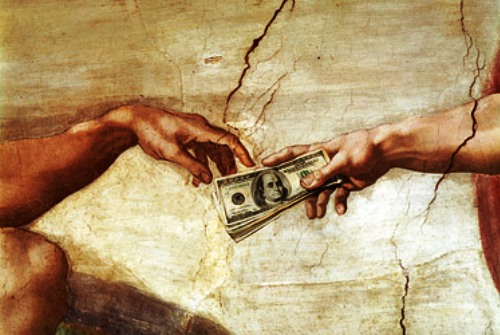
Every year millions of these Christmas boxes are sent all over the world. In the year 2016 the sponsor of these boxes was hoping to send 12 million boxes to eager children. But the boxes are most valuable to the rich people who send them out, thus making them feel generous and benevolent in a cheap sort of way. (A typical box only costs about $15-$25.).
Masks were worn in the Greek theatre for a variety of reasons. One was to enable a single individual to play multiple roles simply by changing a mask.
Masks were also used as a sort of portable microphone system, with its built-in megaphone. It was quite an effective “technology” for the huge amphitheaters before which the actors played. Actors in the Greek theatre were also men only, so they could change their gender simply with the change of a mask.
Ancient building techniques used to begin a new building with the cornerstone. The cornerstone was the determinant of the direction the building faced, the trueness of its walls, and the level of its floors. Every other feature of the building derived from the cornerstone.
The cornerstone must sit on a stable foundation. Builders in San Francisco learned the truth of this when the 58-story Millennium Tower began sinking, to the tune of 17 inches and leaning 14 inches. Developers have finally developed a fix for the tower, but it is going to cost more than its original construction to correct.
Proverbs is the name of the ancient book of Wisdom in the Bible. It is a collection of sayings that shed light on how to live with wisdom and discernment in the world. The ancients were preoccupied with wisdom; in fact, a whole section of the Old Testament was devoted to looking for what is true.
A large number of those proverbial sayings concern truth versus falsehood. Says the Proverbs, “A reliable witness ALWAYS tells the truth, but an unreliable one tells nothing but lies,” Proverbs 14:5. In other words, people do not tend to believe someone who lies.
No one believed Moishe the Beadle (fictional character). He was the keeper of the synagogue in Sighet, Hungary in Elie Wiesel’s famous book Night. Sighet was Wiesel’s hometown.
In the summer of 1941, Hungarian authorities rounded up approximately 20,000 Jews who had not been able to acquire Hungarian citizenship, and deported them to German-occupied Poland.
The Germans massacred approximately 23,000 Jews from August 27-28, 1941 in the first large-scale massacre of the Final Solution. Moishe the Beadle was an archetype of one of these illegal aliens who was swept up in the deportation. Continue reading Truth and Moishe→








 No one believed Moishe the Beadle (fictional character). He was the keeper of the synagogue in Sighet, Hungary in
  MonoLogue